
Last updated August 26, 2026
Free on-site gate assessment - hinges, posts, and your LiftMaster or Nice gate operator checked before anything is quoted
The assessment is free and the quote is the invoice.
Farm & ranch
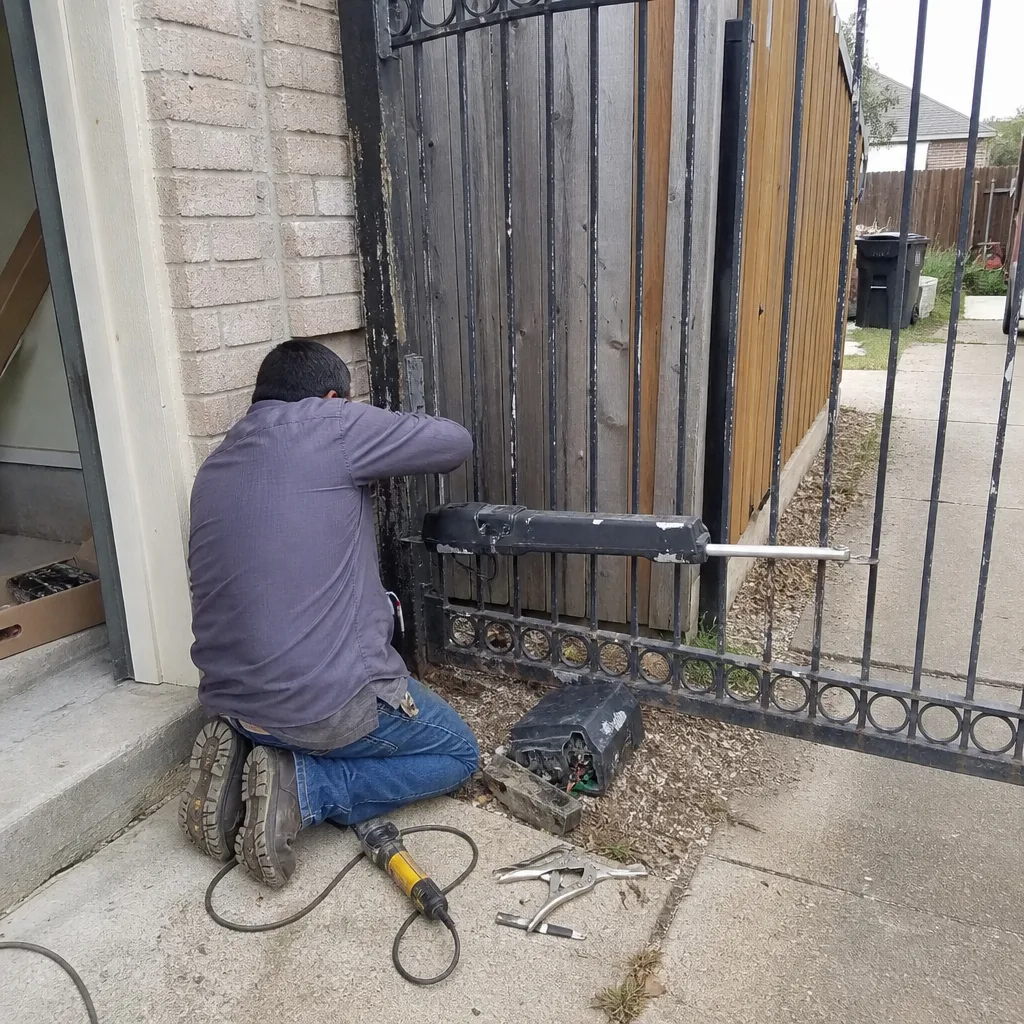 Before
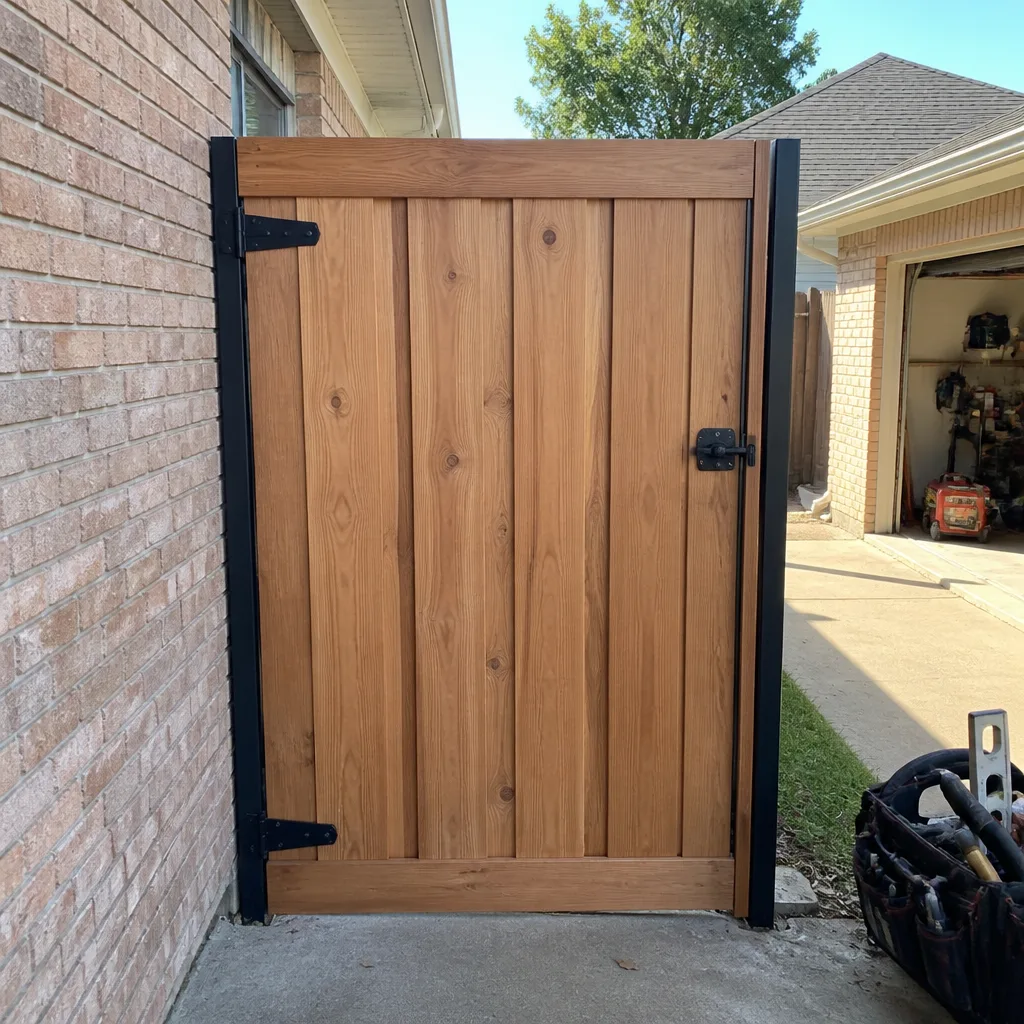 After
After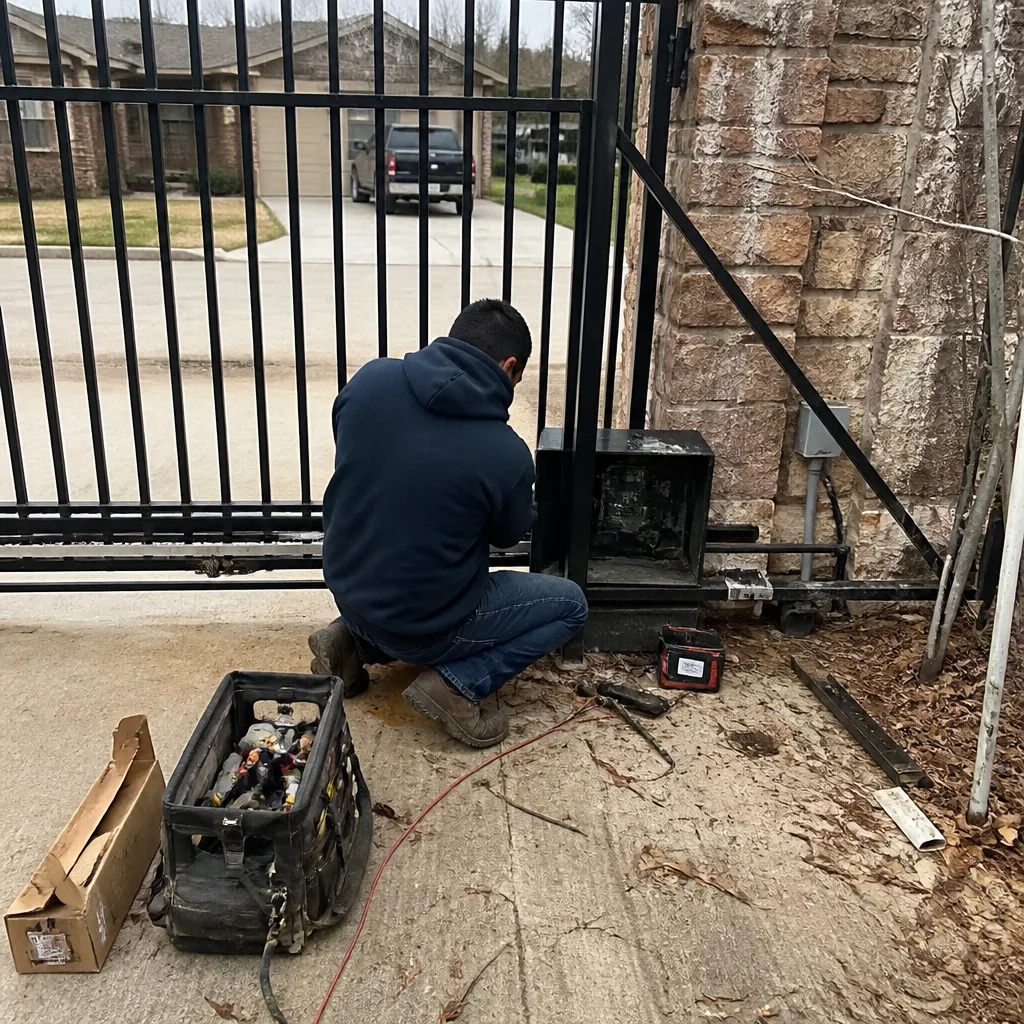 Before
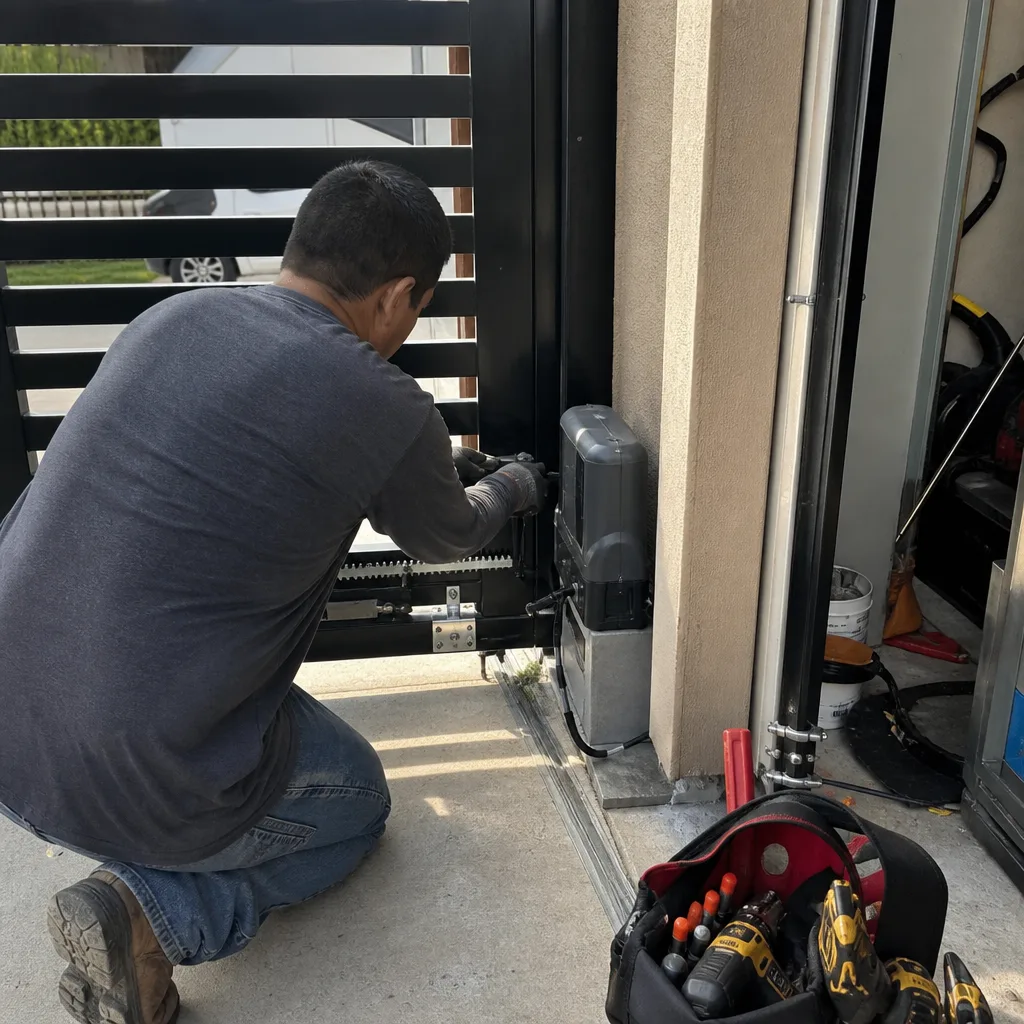 After
After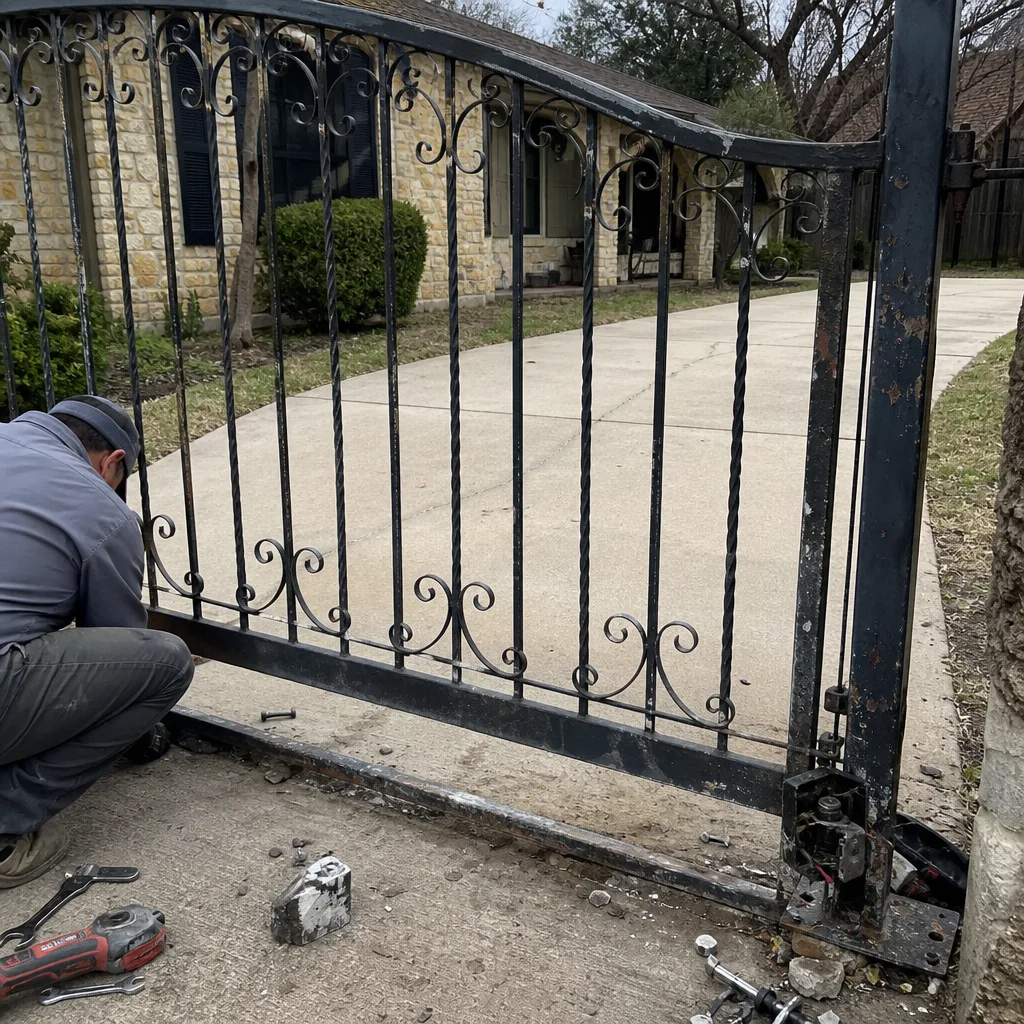 Before
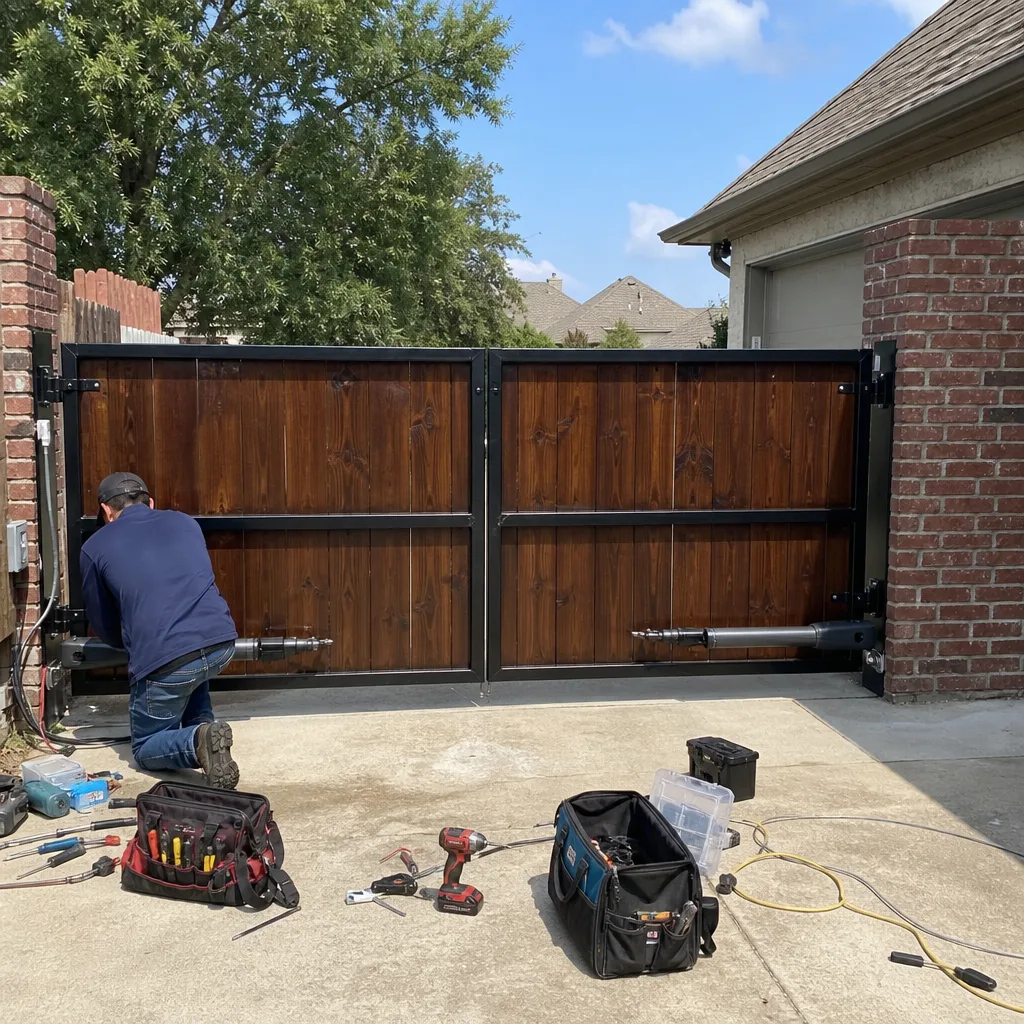 After
AfterGate Repair Warning Signs: A Grand Prairie Homeowner’s Reference Guide
Most gate failures in Grand Prairie announce themselves weeks or months before anything actually breaks. A hinge wears, a post shifts, a motor strains, and the gate leaves a trail of visual and audible clues. The problem is that nobody teaches homeowners what those clues look like. So the gate gets called “suddenly broken” when it’s actually been failing in plain sight since spring. This guide names each warning sign, explains what it means mechanically, and tells you how urgent it is. If you can read the signs, you can fix a $200 hinge before it becomes a $1,400 post replacement.
Quick Answer
A gate that needs repair will show you: sagging or dragging on one corner, a gap opening at the hinge side, grinding or hesitation from the opener, rust advancing past surface stage, or a latch that no longer seats cleanly. Any one of these means the gate is working harder than it should, and the fix is always cheaper before the part fully fails. In Grand Prairie, most our Gate Repair services address issues that could have been caught six months earlier with a five-minute inspection.
Table of Contents
- The Sagging Gate: Hinge Wear Versus Post Movement
- What Grinding, Clicking, and Hesitation From an Opener Actually Mean
- How Rust Progresses on Ornamental Iron Gates
- The Three Ways a Gate Latch Warns You Before It Fails
- Wooden Gates in Grand Prairie’s Humidity Swings
- Track and Roller Problems on Sliding Gates
- Reading Frame Stress: Where the Metal Tells You It’s Tired
- Common Mistakes to Avoid
- When to Call a Professional
- Frequently Asked Questions
- The Bottom Line
The Sagging Gate: Hinge Wear Versus Post Movement
A gate that sags will always drag at the latch side, but the cause is not always in the middle of the gate where the drag shows up. Hal has a saying: a gate sags in the hinge post, not in the middle. That distinction matters because the two fixes are completely different in price and scope, and a lot of homeowners spend money fixing the wrong one.
Hinge wear shows itself as a gap that opens between the hinge leaf and the post, or visible play when you lift the latch end of the gate. The gate drops maybe a half inch to an inch. The hinges are the worn part. Replacement hinges for most residential gates run $40 to $120 per hinge installed, and the job takes an hour or two. This is the good news scenario.
Post movement is a different animal. If the post itself has started to lean, or if you can see a crack in the concrete collar at the base of the post, the gate is pulling the post over. The gate will sag more every month. Fix the panel without the post and you’ll fix it twice. Post repair means digging out and resetting the post in new concrete, which runs $500 to $1,400 depending on access, and the gate stays down for a couple of days while concrete cures. If the post is on a brick or stone pillar, the range goes higher because the pillar may need partial rebuild.
Here’s how to tell which one you have in five minutes:
- Open the gate halfway so it’s not touching the ground or the latch post.
- Grab the latch-side corner and lift up. If it moves more than a quarter inch and you can see the hinge barrel shift, you have hinge wear.
- Step back and sight down the hinge post. A plumb post is vertical. A leaning post will look off even by a few degrees.
- Look at the concrete or brick around the post base. Hairline cracks radiating out from the post mean movement.
- If the post is moving, stop using the gate daily and call a professional before the post fails outright.
In Grand Prairie, the clay soil expands and contracts with rain and drought, and that cycle shortens the life of gate posts that were set shallow or without proper concrete. We see more post movement here than in rocky-soil parts of the metroplex. Gate repair in Grand Prairie usually starts with a post check, because that’s where the truth lives.
What Grinding, Clicking, and Hesitation From an Opener Actually Mean
Automatic gate openers make three distinct bad sounds, and each one points to a different failure. A lot of calls we get start with the homeowner saying “it’s making a noise” and end with us finding something that should have been addressed weeks earlier, as covered in our Seasonal Gate Repair Care for Grand Prairie: Year-Round Homeowner’s Guide. Here’s what each sound indicates, from least to most urgent.
Clicking usually means the opener’s internal limit switches or the capacitor are on their way out. The motor tries to start, the capacitor fires a weak charge, and you hear a click but no movement. Sometimes it’s a low battery on a solar-charged system, common on gate motors and openers in Grand Prairie where summer heat shortens battery life. Clicking is a warning, not an emergency. But it will become one.
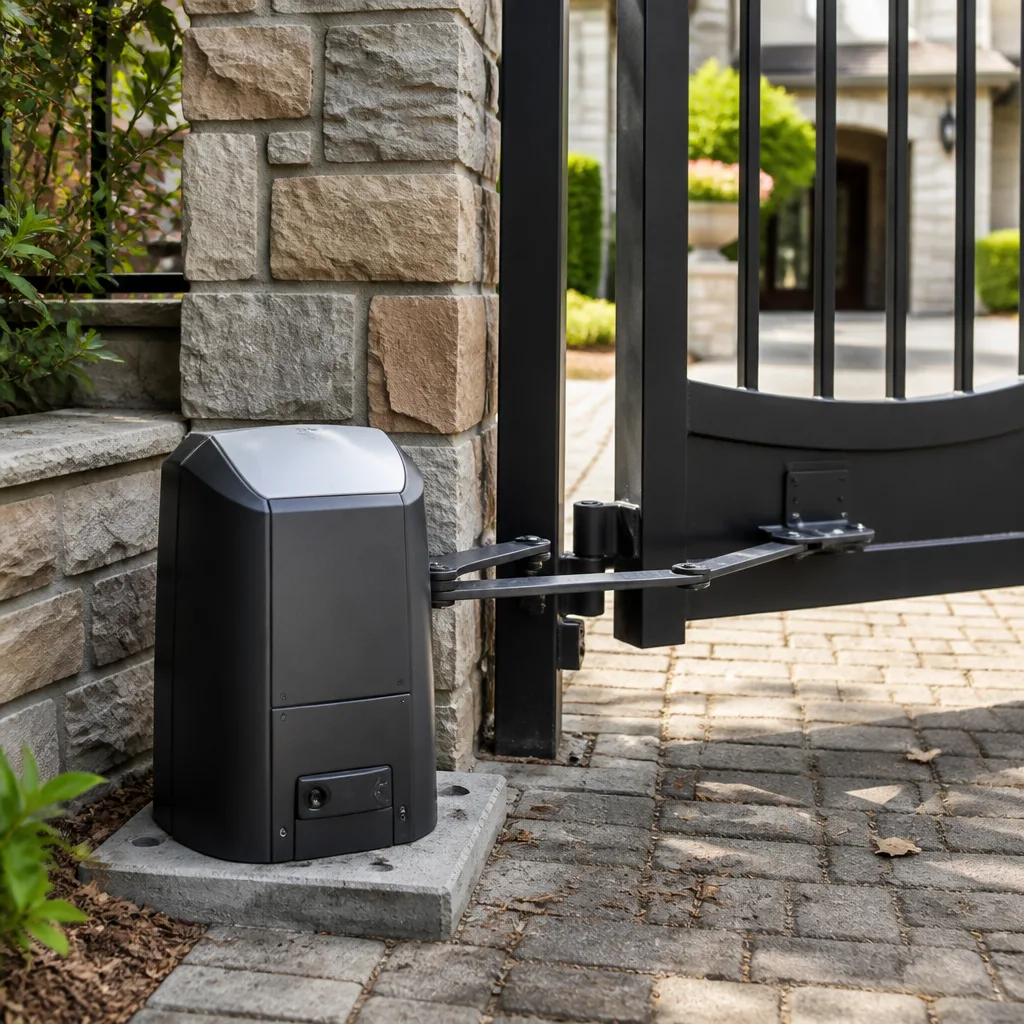
Grinding means metal on metal where metal shouldn’t be touching. On a sliding gate, it’s often the drive gear wearing against the rack. On a swing opener, it’s usually the internal gearbox running dry or with broken teeth. Grinding says the opener is destroying itself slowly. Every cycle makes it worse. This is the sound to stop the gate and call someone today.
Hesitation is when the gate pauses for a second or two mid-cycle, then continues. It can be a weak capacitor, a binding hinge forcing the motor to work harder, or a control board starting to fail. Hesitation is the gate telling you the load has changed. Something is working against the motor, and the motor is losing.
A note on brands: Viking and DoorKing openers tend to fail with control board issues first, where the gate acts erratically rather than stopping outright. Ghost Controls systems often show voltage problems through hesitation on battery units. We service all three and more, but the sound patterns hold pretty consistent across brands.
The short version: clicking means watch it, grinding means stop using it now, hesitation means diagnose it this week. Show me the gate closing on its own and I’ll show you where it’s failing.
How Rust Progresses on Ornamental Iron Gates
Rust is not a single event. It’s a progression, and knowing which stage your iron gate is in tells you whether you need a wire brush or a section replacement. We’ve repaired hundreds of ornamental iron gates across Grand Prairie, and the progression is always the same.
Stage One: Surface oxidation. The gate shows light orange or brown dusting, usually starting at welds, scroll joints, and bottom rails where water collects. At this stage, the metal underneath is still sound. A wire brush, rust converter, and fresh paint stops it. This is a weekend job if you’re handy. Most gates hit Stage One within five to ten years in our climate, especially gates near sprinkler systems.
Stage Two: Flaking and pitting. The rust has begun to lift the paint and etch the metal surface. You can see rough patches and small pits when you scrape away the loose material. The gate is still structurally fine, but the clock is running. Professional treatment now - grinding, priming, painting - costs a fraction of replacement. Put this off and you move to Stage Three.
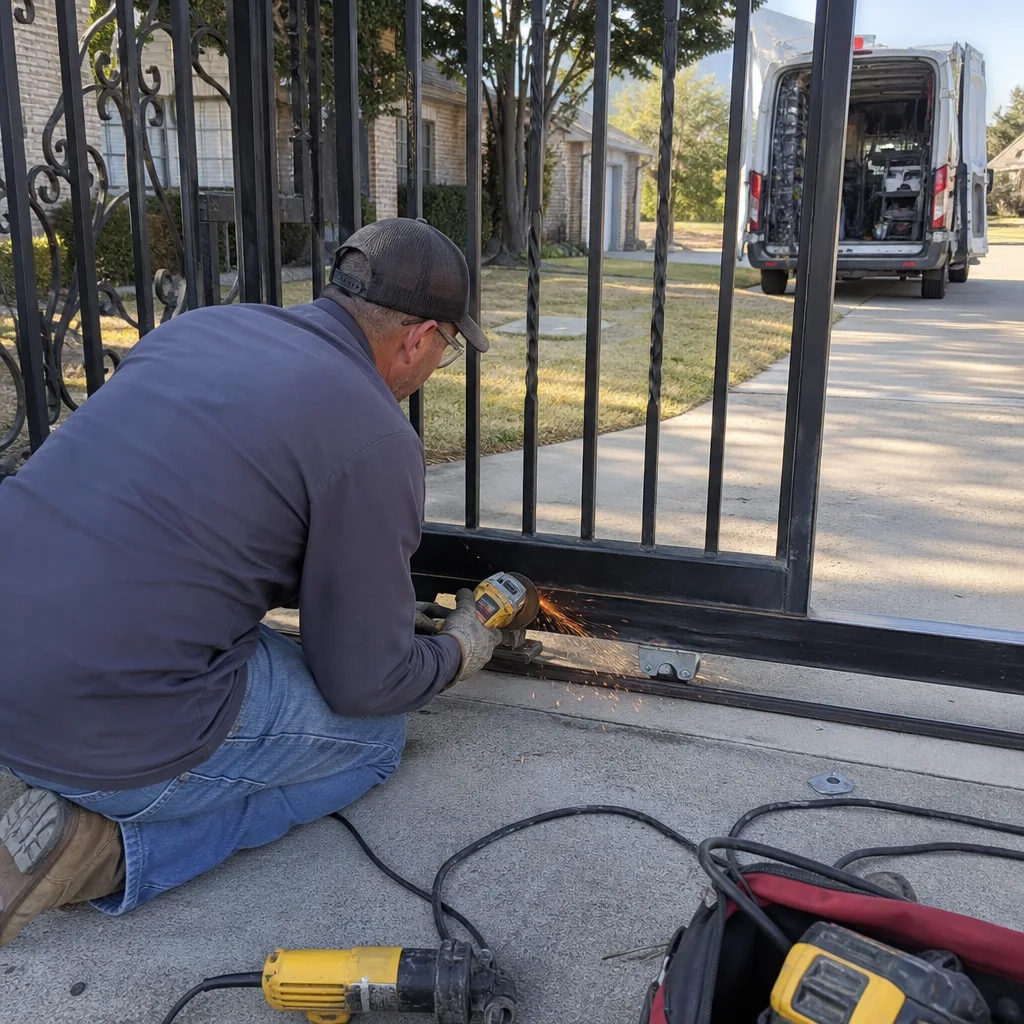
Stage Three: Structural compromise. The rust has eaten through the metal at thin points: scrollwork, the bottom rail, around hinge welds. You can poke a screwdriver through it. At this point, surface treatment won’t save the gate. Sections need cutting out and welding in new material. That’s exactly the kind of repair we do at Gatewood Fence & Gate, where we weld on site and the gate stays in your driveway.
The biggest rust accelerators in Grand Prairie are lawn sprinklers hitting the gate every morning and the clay soil holding moisture at the post base. If your gate sits within spray range of a sprinkler head, move the head or adjust the arc. That single change buys years.
The Three Ways a Gate Latch Warns You Before It Fails
A gate latch that’s about to fail gives you three distinct warnings, and most people dismiss all three. That’s a problem, because a failed latch isn’t just an inconvenience. A gate that won’t latch is a gate that won’t close, and a gate that won’t close is no longer doing the job you bought it for. In a city the size of Grand Prairie, an unlatched gate is an open invitation.
Warning One: The latch no longer seats without help. You have to lift the gate, jiggle it, or slam it to get the latch to catch. This means the gate has shifted - usually hinge wear or post movement, covered above - and the latch is the first component to feel the misalignment. Fix the alignment and the latch usually recovers. Ignore it and the latch gets damaged by repeated forcing.
Warning Two: The latch handle gets stiff or loose. Stiffness means internal corrosion or a bent internal mechanism. Looseness means the return spring inside the latch body has broken. Both are signs that the internal parts are failing. The latch will work fine until one day it doesn’t, and that day is always the day you’re running late.
Warning Three: The latch tongue doesn’t fully extend into the strike plate. Look at the latch with the gate closed. If the tongue only goes halfway into the hole, the strike plate and the latch have drifted out of alignment. This is the most dangerous stage because the gate can pop open from wind, a nudge, or a small child leaning on it. If you can see less than a full tongue engaged, stop using the gate as a security barrier and get it aligned.
Latch replacement itself is modest - $35 to $90 for a good residential latch, and usually under an hour of labor. The expensive part is the alignment work if the gate has sagged badly. That’s another reason to catch hinge wear early.
Wooden Gates in Grand Prairie’s Humidity Swings
Wooden gates fail differently than iron gates, and Grand Prairie’s weather is rough on them in a specific way. The humidity swings - wet springs, brutal summers, wet autumns - make wood swell and shrink on a cycle that never stops. Wood gate owners often write off the warning signs as “just how wood acts.” Sometimes that’s true. Often it’s not.
Sticking or rubbing. When a wooden gate starts sticking against the latch post or dragging on the ground, people assume the wood swelled from rain. And that does happen. But if the sticking persists after a dry stretch, the frame has likely racked or the hinges are failing. Wood hinge screws in particular work loose over time because the wood fibers soften with moisture cycling. A gate that rubs in July is a structural issue, not humidity.
Checking and splitting at the frame corners. Wood gates in our area develop cracks at the rail-to-stile joints because the wood expands and contracts at different rates than the fasteners holding it. Small checks are cosmetic. Splits that open up at a joint mean the gate is coming apart at its frame, and the fix is a tear-out and rebuild or reinforcement with steel brackets. We can weld steel bracing onto a wood gate frame and save the gate - it’s one of those jobs other companies won’t touch but we do regularly.
Soft spots at the bottom rail. Run your hand along the bottom board and press with your thumb. If the wood gives, it’s holding moisture and rotting. Grand Prairie’s clay soil keeps water at ground level, and sprinklers soak the lower rail. This is the most common wood gate failure point. The rot spreads upward, and by the time the gate sags, the bottom rail is mostly gone.
For wooden gate owners in Grand Prairie, the most useful habit is a quarterly three-minute check: lift the latch corner, sight the frame for square, and press the bottom rail for softness. Do that and you’ll catch rot and racking before the gate fails.
Track and Roller Problems on Sliding Gates
Sliding gates fail differently than swing gates. They carry all their weight on rollers riding on a track, and when the rollers wear, the gate’s whole geometry changes. The symptoms are specific, and once you know them, they’re easy to identify.
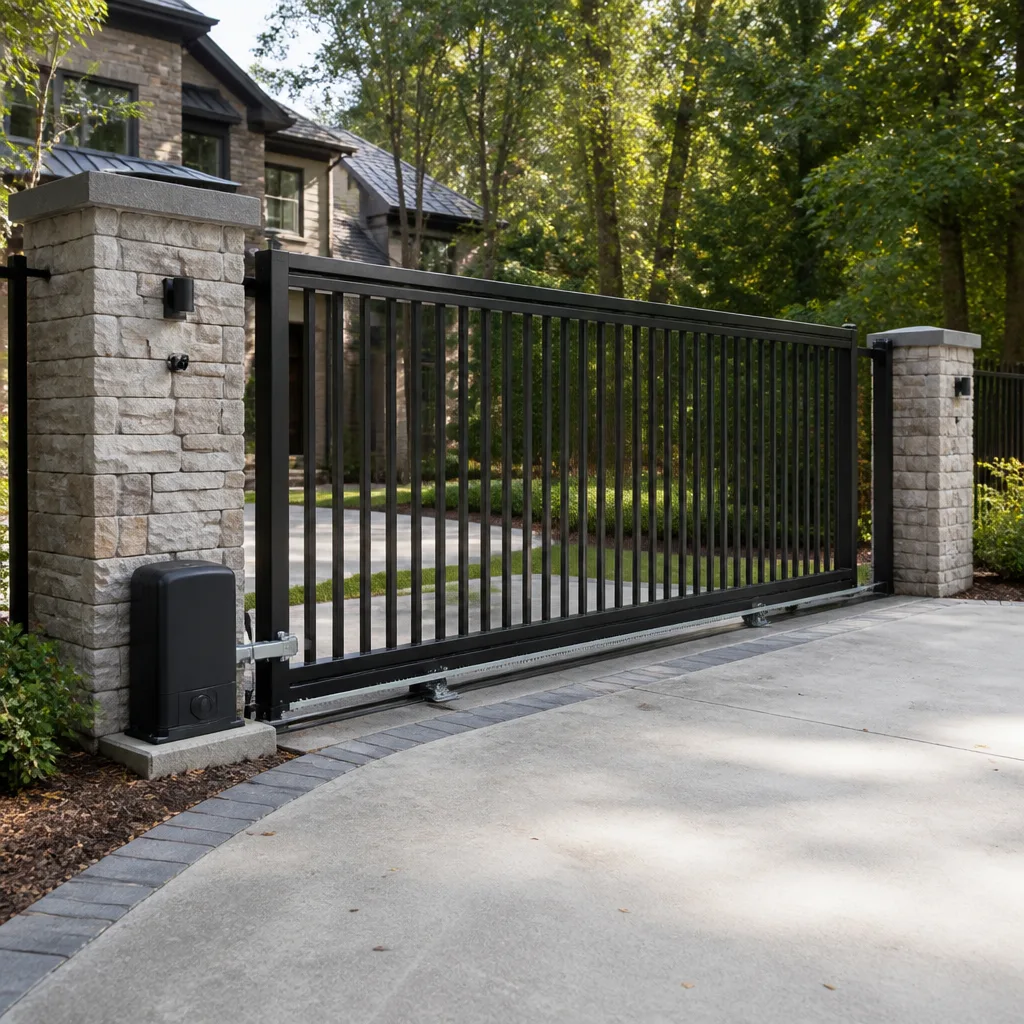
A gate that’s hard to push. Sliding gates should move with moderate effort by hand even when electric. If the gate gets progressively harder to slide - like it’s fighting you - the rollers are binding or the track has debris. In Grand Prairie, crushed gravel driveways and clay mud are constant track contaminants. A hard-pushing gate is usually a cleaning and adjustment issue if caught early, but a bent track or shot bearings mean replacement parts.
Wobble at the free end. When a sliding gate is open, the free end should sit steady on its rollers. If it waves side to side or bounces when you touch it, the rollers are worn or the track has a low spot. Run the gate slowly and watch each roller. A roller that doesn’t spin is dragging, and a dragging roller flattens itself into a flat-spotted failure.
Loud screeching or rhythmic thumping during travel. Screeching is metal-on-metal at the roller bearings, which means they’re dry and failing. Thumping is a flat spot on a roller or a dip in the track. Both are “fix now” sounds. The motor is pushing against a bad bearing, and openers burn out under sustained extra load.
Roller replacement runs $45 to $150 per roller depending on weight capacity, and track repair or replacement runs more. But catching a bad roller early keeps the track straight, and that’s the expensive part. Gate installation in Grand Prairie always includes a track and roller inspection as part of the job.
Reading Frame Stress: Where the Metal Tells You It’s Tired
Metal fatigues visibly before it breaks. The gate shows you the stress in the frame, in the hinge gap, in the way the latch sits. You just need to know where to look. After twenty-plus years of weld repairs on Grand Prairie gates, these are the stress points we check first on every call.
The hinge side stile, top and bottom. On a swing gate, the hinge side of the frame takes the most load. Look at the weld where the top rail meets the hinge stile. If the paint has cracked in a circle around the weld, the metal is flexing there. Hairline cracks in paint at a weld joint mean the weld is starting to fail. That’s a $150 weld repair today versus a full frame replacement later.
The latch side stile, at the mid-rail. When a gate sags, the latch side drops and the mid-rail pulls away from the stile. Look for a gap opening at that joint, or paint peeling in a diagonal line - that’s the paint showing you the direction of stress.
The bottom rail, center span. If the bottom rail is bowed downward in the middle, the gate’s own weight has overcome the frame’s stiffness. This is structural fatigue, and it accelerates. A bowed bottom rail changes the gate’s geometry and throws off the latch alignment even if the hinges are fine.
We see these patterns most often on gates installed by companies that used lighter-gauge steel than the span required. In our climate, with Grand Prairie’s heat and wind load, an undersized frame will show stress within a few years.
Common Mistakes to Avoid
- Lubricating a grinding opener. Grease on the outside of a grinding gearbox does nothing for the metal eating itself inside. Grinding means disassembly and inspection, not a spray can.
- Tightening hinge screws into stripped wood. If the screw won’t hold, the wood has failed around it. Packing it with filler and re-driving the screw just delays the drop by a few weeks. The fix is a threaded insert or bracket.
- Painting over Stage Two rust. Paint traps the rust against the metal and it keeps eating. The surface has to be ground clean first, or you’re paying for a paint job that lasts one season.
- Replacing the opener when the gate is binding. The new opener will grind and burn out the same way the old one did, because the real problem is the hinge or roller making the motor work double. Fix the gate first, then the opener.
- Ignoring a gate that bounces in the wind. Wind load on a Grand Prairie afternoon storm will finish what fatigue started. A gate that moves in the wind is telling you the hinges or the post are losing their grip.
- Assuming a sagging gate just needs a lift-and-weld at the hinge. If the post is the problem, welding the gate to a moving post just pushes the failure deeper. The post has to be set right first.
When to Call a Professional
You’ve read the signs. Some you can address yourself with a wrench and a Saturday. Others need a welder, a post remover, or a control board diagnostic - and those are not driveway jobs for a first-timer. Call a professional when the post is moving, when the frame shows cracks at weld joints, when the opener grinds or hesitates repeatedly, or when the gate will not align no matter how you adjust the hinges. Hal Gatewood has been repairing gates since 2001, and he’ll tell you straight whether it’s a fix or a replace. Gatewood Fence & Gate offers free estimates in Grand Prairie - call (903) 829-4499 and the person who answers will be a live one, not a recorded menu.
Frequently Asked Questions
Most gate repairs in Grand Prairie run between $125 and $650 depending on the component. A hinge replacement is typically $120 to $280 installed. A gate post reset runs $500 to $1,400. An opener repair or control board replacement runs $180 to $550. These are ranges, not promises - but whatever the number is, you’ll hear it before we start, and it won’t change when the job is done. Call (903) 829-4499 and we’ll give you a straight price over the phone for most common repairs.
For emergency repairs - a gate that won’t close, a post that’s leaning, a gate that’s pinned open - we can usually get there same day in Grand Prairie. For non-emergency work, we schedule within a day or two. A live person answers the phone 24 hours a day, not a voicemail, so you’ll know your slot before you hang up.
Hal’s rule is simple: if the frame is sound and the post is set, repair it. Most gates that get replaced didn’t need to be. We repair what other companies want to replace, because welding on site costs less than a new gate and keeps your gate in your driveway. If the frame is rusted through or the gate was undersized from day one, we’ll tell you that too.
We service nine major brands: LiftMaster, FAAC, BFT, Linear, Viking, Ghost Controls, DoorKing, Elite, and Mighty Mule. That covers the vast majority of openers installed in Grand Prairie homes. If you’ve got something odd, call and ask - if we can’t fix it, we’ll be honest about that.
It’s written on every job we do: if it’s not done right, we make it right, for 90 days. One call brings Hal back to the gate. No runaround. The name is on the shop, and the shop is down the road - that’s the oldest accountability there is.
Yes. Estimates are free, there’s no trip charge inside the county, and we’ll also honor a free second opinion on any written estimate you’ve gotten from another company. If you’re sitting on a quote, bring it over or call it in - we’ll tell you if it’s fair.
The Bottom Line
Gate failures are telegraphed. The sag, the sound, the rust, the latch that needs a nudge - each one is the gate telling you what’s wrong and roughly when it’s going to let go. Learn the signs and you’ll pay for hinge replacements instead of post resets, roller swaps instead of track rebuilds, and weld repairs instead of whole new gates. In Grand Prairie, our soil, sprinklers, and summer heat are hard on gates, which means the inspection habit matters more here than in most places. Spend five minutes a month looking at your gate. When you see something wrong, call someone who’ll look you in the eye and tell you the truth, or explore more guides & resources to keep your gate running.
Written by Hal Gatewood, Owner at Gatewood Fence & Gate, serving Grand Prairie since 2001.